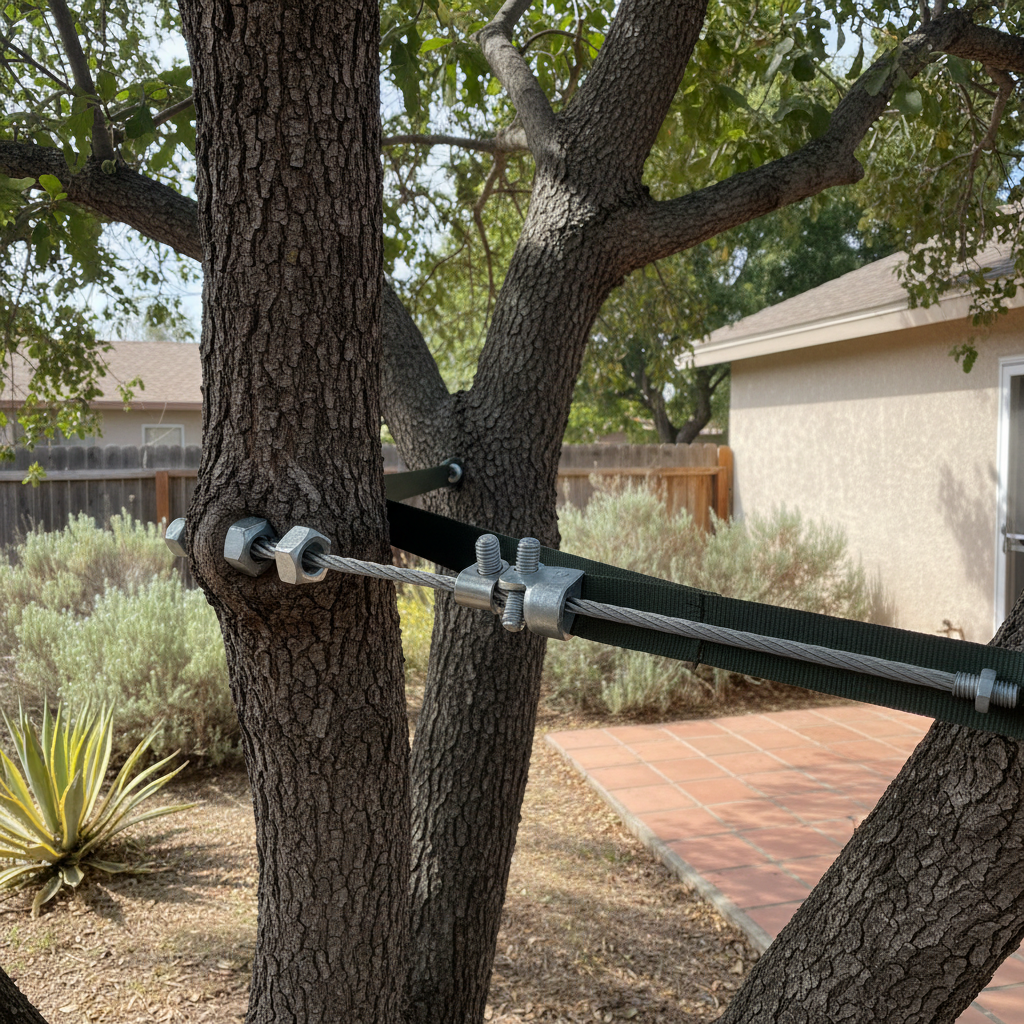
What exactly is tree cabling and bracing? Aren't they the same thing?
Nah, they're not the same, though people often lump 'em together. Think of it this way: cabling uses strong steel cables to connect two or more weak limbs or multiple leaders (trunks) of a tree. It's like putting a seatbelt on a branch, giving it extra support to prevent it from splitting further or breaking off in a high wind. We're usually talking about dynamic support here, allowing for some natural movement.
Bracing, on the other hand, is more rigid. It involves installing steel rods through weak or splitting unions in the tree. It's like putting a pin in a broken bone to hold it steady while it heals or to prevent a split from getting worse. We use bracing when we need to limit movement significantly. Sometimes we'll use both on the same tree, depending on what kind of weakness we're dealing with.
How do I know if my tree needs cabling or bracing?
Most of the time, you'll notice something's off. Maybe you've got a tree with two main trunks that are growing really close together, forming a 'V' shape. These V-shaped unions are notorious for splitting, especially if they're holding a lot of weight or catch a lot of wind. Or maybe you've got a large, heavy limb that's extending way out and looks like it's about to snap. You might even see an existing crack or split in a branch union. If you're seeing any of that, it's a good idea to get an arborist out to take a look. We're looking for structural weaknesses that could lead to failure, especially important with our occasional Santa Ana winds ripping through National City.
Will cabling or bracing hurt my tree?
When done right, no, it won't hurt your tree. In fact, it's a way to help it. We use non-invasive techniques, like drilling through the branches for bracing rods or installing eye bolts for cables, and we make sure to do it in a way that minimizes impact on the tree's health. The goal is always to improve the tree's structural integrity, not compromise it. We're careful about where we place hardware and how we tension the cables so the tree can still grow and move naturally within its new support system.
How long does cabling and bracing last? Do I need to replace it?
That's a great question, and it depends on a few things. Modern cabling systems, especially those using extra high strength (EHS) steel cable and thimbles, are designed to last a long time – often 10 to 20 years or even more. Bracing rods are usually permanent. However, trees grow! As your tree gets bigger, the hardware might need adjustment, or the support might become less effective relative to the tree's increased size and weight. We recommend getting your cabled or braced trees inspected every few years, especially after any major storms. It's not usually a 'set it and forget it' situation for the life of the tree, but it's not something you'll be replacing every other year either.
Is this a DIY project? Can I just buy some cable and do it myself?
Absolutely not. Look, I get it, people like to save a buck. But this isn't a weekend warrior project. Cabling and bracing involves working at height, understanding tree biomechanics, knowing the right hardware to use, and how to install it without causing more damage. You need specialized tools, proper safety gear, and the knowledge to assess the tree's specific weaknesses. If you do it wrong, you could actually make the tree more dangerous, or even kill it. It's one of those jobs where you really need a certified arborist who knows what they's doing. Trust me, it's worth hiring a professional like National City Tree Service to ensure it's done safely and effectively.
What's the difference between dynamic and static cabling?
Okay, so this gets a bit technical, but it's good to know. Static cabling uses rigid steel cables that are installed pretty tightly. The idea here is to prevent almost all movement between the supported limbs. We use this when we really need to restrict movement, like if there's an existing split that we don't want to get any worse. Dynamic cabling, on the other hand, uses synthetic ropes or sometimes specialized steel cables that allow for a bit more flexibility and natural sway. It's designed to absorb shock and distribute stress without completely immobilizing the branches. We often use dynamic systems on younger trees or when we want to encourage the tree to build its own reaction wood to strengthen itself over time. It's all about balancing support with the tree's natural growth.
When is cabling or bracing NOT a good idea?
Cabling and bracing are great tools, but they're not a magic bullet for every tree problem. If a tree is already severely decayed, has extensive internal rot, or is just too far gone structurally, cabling might only delay the inevitable. Sometimes a tree is just too large or too compromised for cabling to be a safe or effective long-term solution. Also, if the tree is in a location where its failure would cause catastrophic damage, like right over your kid's bedroom, we might lean towards removal even if cabling could buy some time. It's always a judgment call based on the tree's health, its location, and the level of risk involved. We'll give you an honest assessment.